FFS film without downtime: how to keep your line running
Is your FFS line stopping? The cause often lies in the film. Learn which faults we see most and how the right FFS film keeps your line running.
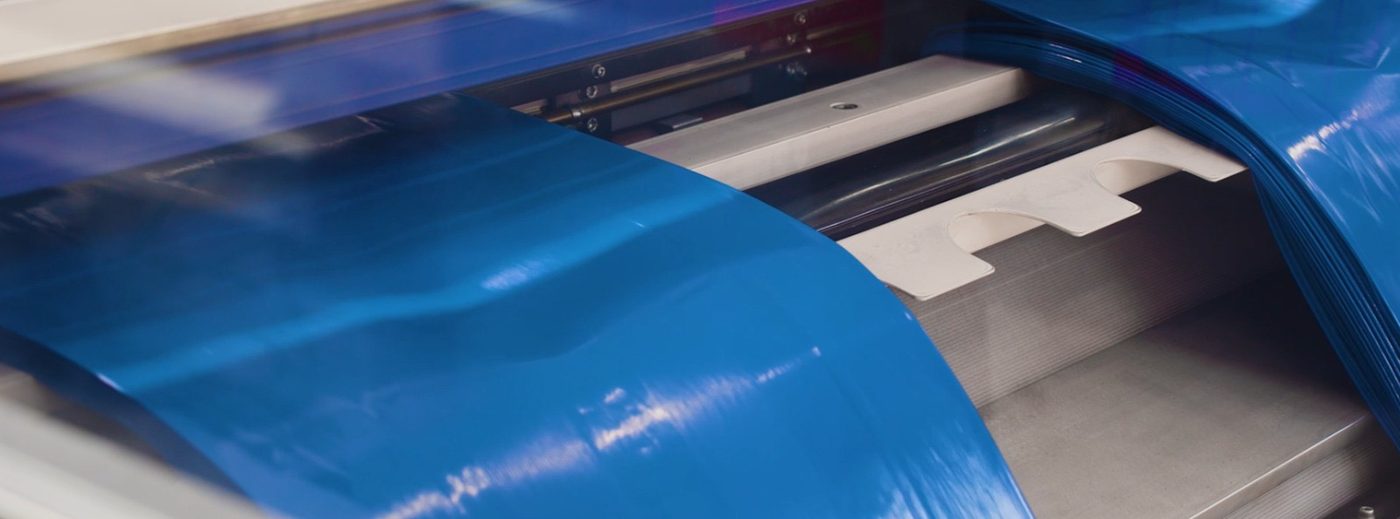
Your FFS line stops, the operator looks for the cause and meanwhile your production falls behind. Often the problem isn’t the machine but the FFS film. By matching the film to your machine, product and line speed, you prevent breaks and downtime before the first reel is even on the line.
Why downtime on an FFS line often starts with the film
An FFS line (form, fill and seal) forms, fills and seals your packaging in a single pass. The film is unwound continuously, formed around the product, sealed and cut. Any weakness in the material shows up immediately.
Breaks and faults are often a material issue. These are the problems we see most:
- Seals that don’t hold or leak. The film’s sealing temperature doesn’t match your machine, or product gets into the seal area.
- Film that slips or snags. The film’s slip properties aren’t matched to the forming shoulder and the transport belts.
- Breaking or stretching at high speed. The film lacks the tensile strength for your product weight or line speed.
- Web wander or a poor seal seam. The thickness isn’t evenly distributed across the width of the reel.
You know the result: line stoppages, repacking and lost production.
The risk is highest when you switch film or supplier. After such a switch, a meat processing company experienced film breaks on its FFS line, which runs at 65 meters per minute. After changing to a film made to Hobon specifications, the breaks disappeared.
Choosing the right FFS film: composition and structure
For FFS lines we usually recommend a multilayer film, with 3 or 5 layers. This lets us combine three functions in one film:
- a strong core that carries the weight of your product;
- an outer layer that runs smoothly over the machine;
- an inner layer that seals quickly and reliably.
A monolayer film is sufficient for simpler applications and lower speeds. What determines the choice: the weight and nature of your product, your line speed and the way your machine seals.
Hobon produces FFS film in-house in Lievegem, Belgium, flat or pleated, in HDPE or LDPE and in widths up to about 1400 mm. Depending on your product and line, we add anti-static additives, corona treatment, anti-UV or microperforation. Flexographic printing is possible up to 6 colors, in our own print shop.
Which values for tensile strength, sealing behavior, slip and thickness distribution you need is explained in our article High-speed FFS film: which specs make the difference? We match those specifications to your machine before you order. Explore the options for our custom FFS film.
The information we need to give you the right advice
Not a catalog choice, but a film that suits your line. That’s why we start by asking the right questions:
- Your machine: type of FFS line, exact line speed and the settings of your sealing jaws.
- Your product: type and weight per pack.
- Your requirements: retailer requirements and audits.
- Your goals: sustainability targets, such as less material or recyclate.
Line speed and sealing jaw settings are what customers most often don’t have to hand. And when switching, often nobody remembers the spec of the previous film. That’s why we like to receive a sample or the technical data sheet of your current film.
In the food industry, we mainly supply FFS film to bakeries and vegetable companies. There’s no room for the wrong material choice there. We make films for food applications from virgin PE suitable for food contact, and Hobon is BRC Packaging Level AA certified. So your film also stands strong in an audit. Read how we approach packaging film for the food industry.
More sustainable packaging without sacrificing speed
Sustainability and line speed don’t have to clash, as long as the spec is right. With FFS customers, we look at two options:
- Thinner first. We check whether the film can be thinner without losing strength. That means less plastic and lower costs straight away.
- Then recyclate, where the application allows it. For direct food contact, virgin PE is the safest choice. Recyclate isn’t completely ruled out there: with a closed loop of our own post-industrial recyclate (PIR), it is possible in some cases. We assess this case by case.
Frequently asked questions
We’re switching suppliers. How do we avoid problems during the changeover?
Send us a sample or the technical data sheet of your current film, together with your line speed and sealing jaw settings. With our many years of experience, we match the new film to these, so your line keeps running.
Can we test a trial reel on our line first?
Of course. A trial reel on your own line is the best test before you switch.
What is the lead time for custom FFS film?
Allow 2 to 4 weeks. If you’re planning to switch film or supplier, contact us in good time so the new film is ready when you change over.
Is your FFS line stopping too often, or are you planning to switch film or supplier? Tell us about your line. We’ll look at your machine, product and line speed and propose the film that keeps it running. Discuss your packaging needs.