Plastic bags for your filling line: how to choose the right bag type
Are your bags tearing or is your filling line stopping? Learn which problems we see most and how to choose plastic bags that suit your product and your machine.
A bag that tears during filling, a seal that bursts open in the warehouse or a filling line that stops because the bags don’t open properly: it costs you product, time and repacking. With industrial plastic bags, the cause often lies in a bag type or material that doesn’t suit your product or your equipment. Getting that right before you order prevents these problems.
Why the wrong plastic bags bring your line to a halt
Every filling installation and every product needs its own bag. If the seal, the way the bags are supplied or the strength isn’t right, your line won’t run. This is what goes wrong most often:
- Seals that don’t hold or burst open. Dust from the product gets into the seal area, or the closure isn’t suited to the product.
- Bags that tear during filling. The film is too thin, or the structure doesn’t suit the weight, drop height or filling speed.
- Bags that don’t open properly. Static charge makes the film stick together, or the dimensions don’t match the machine.
- Powders that create dust or bags that balloon. The air can’t escape. Microperforation solves this.
For products stored outdoors, such as fertilizers, sunlight is an added factor. Film without anti-UV becomes brittle and your product gets damaged.
Which bag type suits your filling line?
Hobon makes bags in-house in Lievegem, Belgium, from simple bags to technical versions. Note: the terms below are not alternatives to choose between. A seal type, a way of supplying the bags and an application can be combined. A crate bag, for example, can come with or without a corner seal.
- Corner seal. The bottom corners are sealed at an angle, so no product is left in the corners when emptying. Recommended for powders and granules that need to empty completely.
- Block seal. The bags are supplied in a block and hung on a stand. You then pull them off one by one. Handy when you fill at a fixed station.
- Crate bag. A bag made to fit your crate. Depending on your product and how you empty the crate, we make it with or without a corner seal.
- Paperlike. For greasy products such as butter, or when you need very strong anti-slip properties.
We also supply bags with or without side gusset, loose or tear-off from the roll.
Material and structure: strong enough for your product
Besides the bag type, the film determines whether your bag holds, from filling to transport:
- Material: LDPE or HDPE.
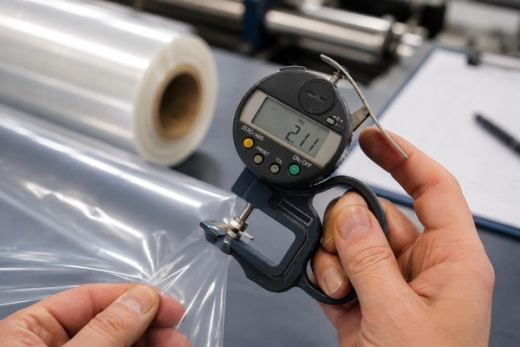
- Layers: mono, 3-layer or 5-layer PE. For heavy products, reinforced PE in 3 or 5 layers, for products up to 50 kg. Heavier on request.
- Sealing technique: band sealing or economical sealing, depending on your product and machine.
- Additions: anti-UV for outdoor storage, microperforation for products that need to breathe or vent, anti-static to stop bags sticking together.
- Printing: product name, composition, batch number or logo, in flexographic printing up to 6 colors.
View all variants of our custom plastic bags.
The information we need to give you the right advice
Everything starts with your application. To suggest the right bag type, we ask about:
- Your product: powder, granules or piece goods, the weight per bag, and food or non-food.
- Your filling installation: manual or automatic, make and model, and filling speed.
- Storage and transport: indoors or outdoors, on pallets, and for how long.
- Your bag: dimensions, printing and annual volume.
What’s most often missing are the specifications of the filling machine. That’s why we prefer to come and take a look on site.
Bags are often used for fertilizers, powders, sand and grains. Read how we match bags to filling lines in this sector on our page on packaging for the agro-industry.
Virgin or recyclate in your bags?
Recyclate works for non-food applications such as fertilizers, sand or industrial products. For food, virgin PE suitable for food contact is the safest choice, and it’s our standard recommendation. Recyclate isn’t completely ruled out there: with a closed loop of our own post-industrial recyclate (PIR), it is possible in some cases. We assess this together with you. Hobon is also BRC Packaging Level AA certified.
Frequently asked questions
What is the minimum order quantity?
Preferably one pallet. If you need a smaller volume, talk to us and we’ll look at what’s possible together.
Can we test a trial batch on our line first?
Of course. That way you can see how the bags perform on your own equipment before you order.
What is the lead time for custom bags?
Allow 4 to 6 weeks. If you’re planning a new bag type or a change of supplier, contact us in good time so your bags are ready when you need them.
Are your bags tearing, or are you looking for a bag type that better suits your filling installation? Tell us about your product and your equipment. We’ll propose the right bag type, sealing and printing. Discuss your packaging needs.