
Thinner film, same quality, lower costs, but how?
Material reduction is the most underestimated sustainability gain, if you align the technical specs correctly.
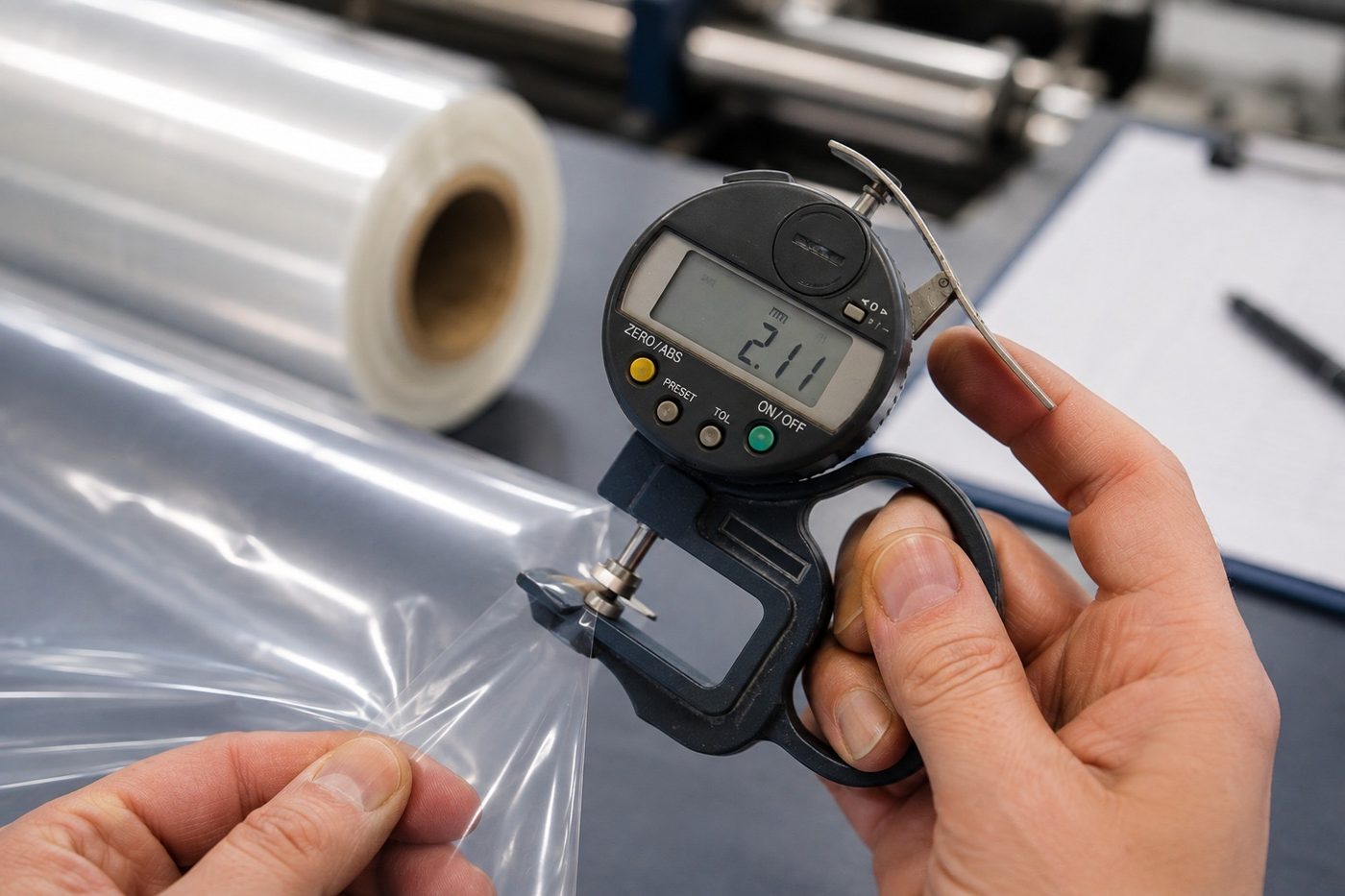
Thinner film, same quality: why advice saves money
Ten years ago, a 50-micron film was standard, whereas today 35 microns is sufficient. For some applications, even 25 microns will do. Material reduction (downgauging) is the most underestimated sustainability gain, and at the same time a direct saving on your cost per package, provided you approach it technically correctly.
Why downgauging often gets left on the shelf
Many companies continue, out of habit, to purchase a thickness that has evolved over time. “We’ve always used fifty microns.” Or the procurement team is reluctant to change a running process that works. Or there was a single test with thinner film that failed, which has since given thinner films a bad reputation.
The problem is usually not that thinner film isn’t possible. The problem is that thinner film made from the same material isn’t possible. Downgauging only works if you simultaneously adapt the material composition, the extrusion technology and, where necessary, the additives.
The three technical levers for downgauging
MLDPE blends instead of LDPE alone. Metallocene LLDPE (mLLDPE) has a much higher tensile strength per micron than conventional LDPE. If you replace part of your LDPE with mLLDPE, you can typically reduce the thickness by twenty to thirty per cent without any loss of mechanical properties.
Multilayer rather than monolayer. A three- or five-layer film, in which each layer has a specific function, performs better than a monolayer of the same total thickness. Outer layers for stiffness and printability, inner layers for sealing performance, and possibly an intermediate layer for a barrier or recycled material.
Optimised extrusion. Modern extrusion lines deliver better thickness distribution and lower gauge variation. In practice, a film with a five per cent thickness distribution can be specified as thinner than one with a fifteen per cent thickness distribution, as you require a smaller safety margin.
How much could this save you?
A calculation example. Suppose you use 250 tonnes of 50-micron film per year. You switch to 35 microns using a modified blend. This results in a 30 per cent reduction in weight (in kilograms). At an average film price of two euros per kilo, this equates to a saving of fifteen thousand euros per year. Plus lower CO₂ emissions per tonne of packaged product. Plus less pallet space required for your film storage. Plus better ESG figures in your reporting.
What do you need to watch out for?
Downgauging has a safety limit. Below a certain thickness, puncture resistance decreases at a rate faster than linear. For heavy products (fertilisers, sand, animal feed), you must remain above a certain threshold. For light products, you can go further. This is precisely where pre-purchase advice makes all the difference.
Have you taken a close look at your film thickness in the last five years? There are likely to be savings to be made. Discuss your packaging requirements.